


What is an electrical steel coil? GO vs NGO, key properties, and why core loss sets the price
An electrical steel coil is sold for one thing: low loss in an alternating magnetic field. This guide explains how silicon, grain orientation, thickness and coating create that property, how to read a specification sheet, and why core loss decides efficiency, temperature rise and price.
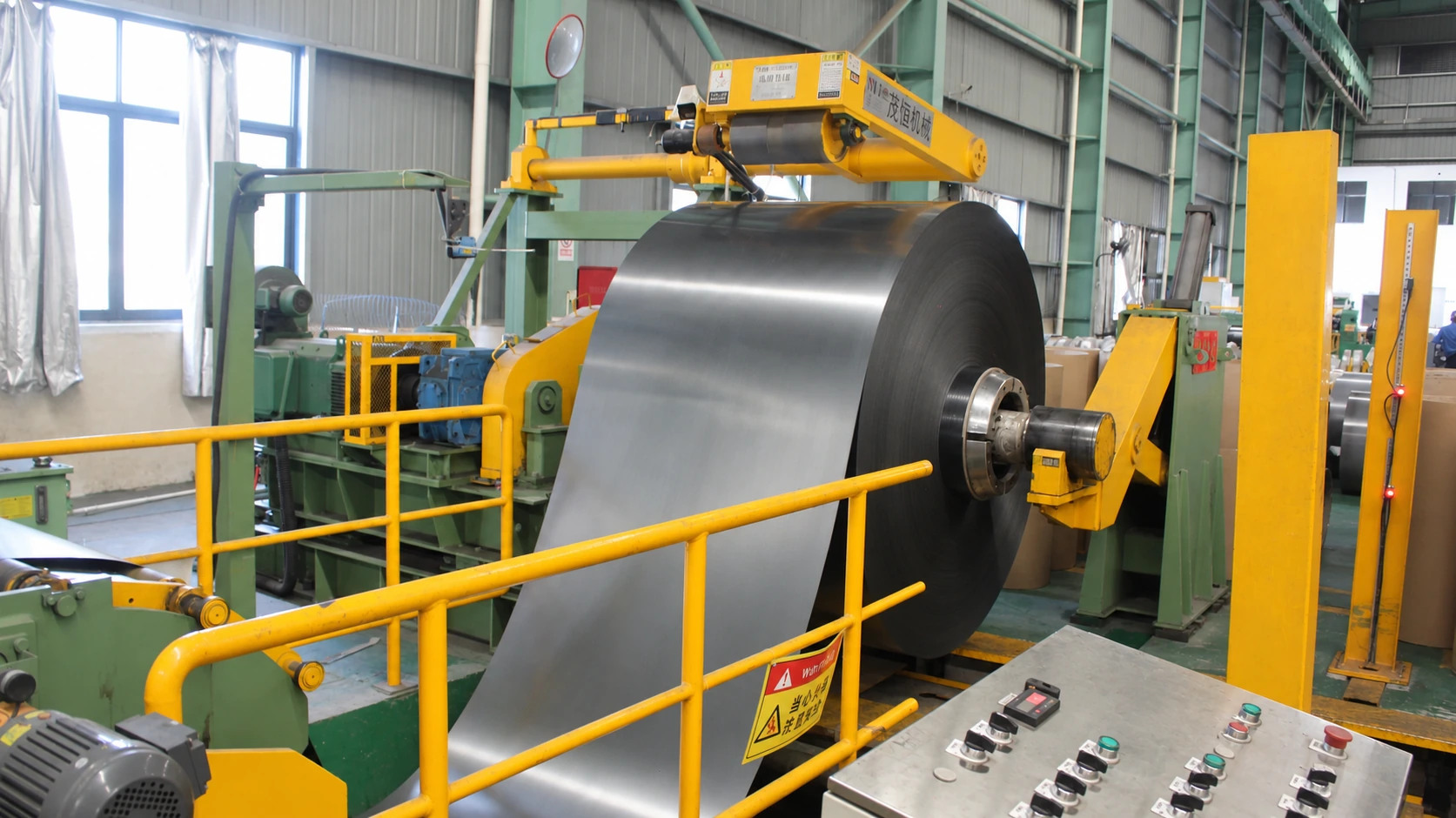
On the slitting line at our Hunan plant, a grain-oriented coil of more than three tonnes is uncoiled, slit and rewound: 1,250 mm of mother coil becomes 900 mm strips with clean edges and burrs held within 0.02 mm. A few hours later the strips go on to cutting or stamping and become part of a distribution transformer core.
The electrical steel coil, often called a silicon steel coil, is where that chain starts. It is an iron–silicon alloy designed to carry magnetic flux, not loads. A tonne of structural steel is bought for its strength; a tonne of electrical steel is bought for how little heat it makes in an alternating magnetic field.
This article answers the questions customers ask us most: what the material is, how GO and NGO differ, how to read the numbers on a specification sheet, how core loss affects the finished machine, and why the same grade can be quoted at different prices by different suppliers.
Key points
- What it is: a low-carbon iron–silicon alloy with about 0.5–4 % silicon, cold-rolled into coils for the magnetic cores of transformers, motors and generators.
- Two routes: grain-oriented steel (GO / CRGO) has its grains aligned in one direction and goes into transformers; non-oriented steel (NGO / CRNGO) behaves the same in all directions and goes into motors and generators.
- Three key numbers: core loss (W/kg), induction (T) and thickness (mm). Most other parameters serve these three.
- The coating is not an extra: if the insulation between sheets fails, core loss can multiply, however good the steel is.
- Core loss is money: it sets the efficiency class, temperature rise, noise and price, and it is the one figure that runs through engineering, purchasing and acceptance.
The ranges below come from public standards and common grades and are given to build understanding. For any specific coil, the measured values on the mill certificate apply.
How it differs from ordinary steel: four design levers
What makes electrical steel special is not one recipe but four levers adjusted together: composition, grain orientation, thickness and surface coating. Understand these four and you understand the product.
1. Composition: silicon raises resistivity
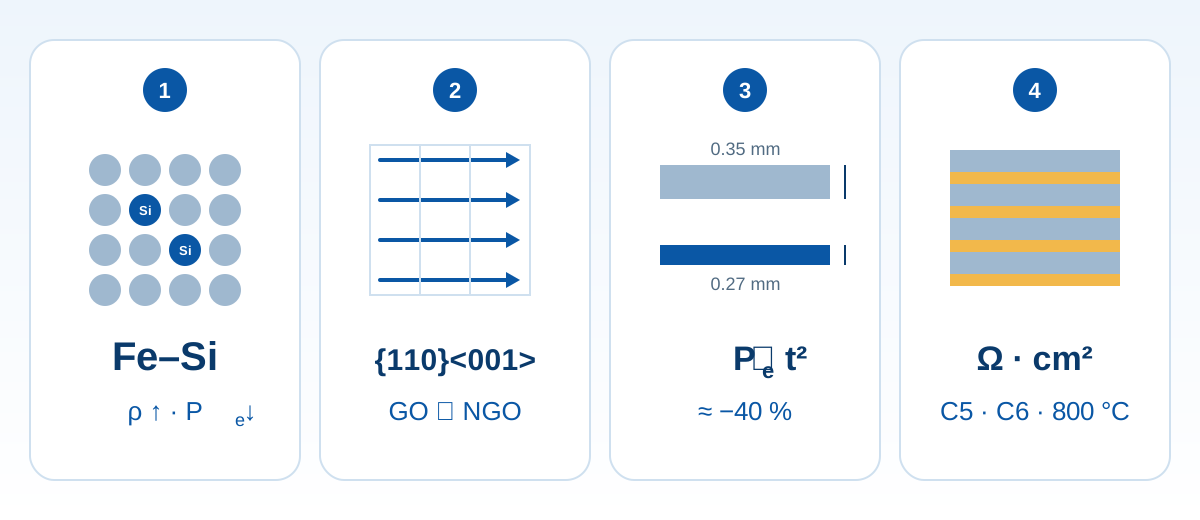
Pure iron has a resistivity of about 0.10 μΩ·m; with about 3 % silicon it rises to roughly 0.45–0.50 μΩ·m. As a rule of thumb, each 1 % of silicon adds more than 0.1 μΩ·m.
Resistivity matters because eddy-current loss in the core is inversely proportional to it: several times the resistivity means several times less eddy loss. This is the main job of silicon in electrical steel, more important than strength or corrosion resistance. The price is real:
- Brittleness rises: the more silicon, the harder cold working becomes and the more easily edges crack in punching and cutting.
- Thermal conductivity falls: heat leaves the core more slowly at the same temperature rise.
- Saturation induction falls: about 2.15 T for pure iron against about 2.03 T for 3 % silicon steel, so the same cross-section carries slightly less flux.
So more silicon is not always better. Grain-oriented steel usually stays near 3 % silicon with inhibitors; non-oriented grades range from 0.5 to 3.5 %, and some higher grades add aluminium to raise resistivity further.
2. Grain orientation: aligning the domains with the flux path
Iron is a cubic crystal whose magnetic behaviour depends strongly on direction; the <001> direction magnetizes most easily.
- Grain-oriented steel: cold rolling, decarburizing anneal and secondary recrystallization produce the Goss texture {110}<001>, so almost every grain has its easy direction along the rolling direction. Hysteresis loss along that direction is very low; as soon as the flux leaves it, the advantage falls quickly.
- Non-oriented steel: the final anneal gives randomly oriented equiaxed grains with similar properties in all directions, weaker than GO in its best direction but usable in any direction.
This sets how they are used. A transformer’s flux path is fixed by design, so GO can be pushed to its limit; in a motor the flux turns with the rotor, so only NGO fits.
3. Thickness: eddy-current loss follows the square
Eddy-current loss is roughly proportional to the square of thickness. Going from 0.35 mm to 0.27 mm brings the eddy component down to about 60 % in theory, a reduction of roughly 40 %. Thin gauge is not free, though:
- More sheets for the same stack height, so more cutting time and die wear.
- A slightly lower stacking factor and a smaller effective core section.
- Thin gauges are harder to roll, with lower yield and a clearly higher price.
- Very thin sheets deform more easily during stacking and handling.
Thickness is therefore a balance between loss, cost and process: 50 Hz transformers commonly use 0.18–0.30 mm GO, industrial motors 0.35–0.50 mm NGO, and only high-frequency or high-efficiency designs go below 0.20 mm.
4. Coating: half insulation, half process
The coating on electrical steel does four jobs:
- Insulation between sheets: it breaks the eddy-current path from sheet to sheet. Without it a stack behaves like solid iron and core loss rises sharply.
- Adhesion: no flaking or powdering during cutting, bending and stacking.
- Resistance to media: long immersion in transformer oil, cutting fluids, coolants and refrigerants.
- Process compatibility: surviving stress-relief annealing at about 800 °C in a non-oxidizing atmosphere; some GO tension coatings also reduce magnetostriction, loss and noise.
Common types include inorganic coatings (such as C5 and C6 classes), semi-organic coatings and self-bonding coatings for bonded cores. Put the coating code in the contract: it decides whether the steel can be annealed, oil-immersed and whether the interlaminar resistance is high enough.
GO and NGO: two technical routes
| Aspect | Grain-oriented (GO / CRGO) | Non-oriented (NGO / CRNGO) |
|---|---|---|
| Grain structure | Goss texture, highly aligned with rolling | Random orientation, isotropic |
| Magnetic anisotropy | Strong, best along rolling | Weak, similar in all directions |
| Silicon / aluminium | About 3 % Si with inhibitors | 0.5–3.5 % Si, some grades add Al |
| Common thickness | 0.18–0.35 mm | 0.35–0.65 mm (0.20) |
| Core loss level | Very low along rolling | Medium, wide range between grades |
| Induction | B8 > 1.85 T | B50 > 1.60 T |
| Main uses | Power and distribution transformers, reactors | Motors, generators, compressors, appliance motors |
| Processing | Direction-sensitive; nesting direction must be right | Direction-free; high nesting yield |
| Price level | High (long process, lower yield) | Low to medium, wide spread between grades |
A common shortcut is “GO for transformers, NGO for motors”. It holds in most cases, but it is simplified. More precisely:
- NGO can make transformers: small dry-type units, reactors and ballasts often use it because it is direction-free, nests efficiently and costs less.
- GO can in theory make motors, but the flux direction does not match, so you pay for performance you cannot use.
- What decides the choice is whether the flux direction is fixed, not the name of the machine.
Baosteel grades show how designations read:
| Grade | Thickness | Type | Max. core loss (W/kg) | Min. induction |
|---|---|---|---|---|
| B23R085 | 0.23 mm | GO, domain-refined | 0.85 · P17/50 | B8 1.87 T |
| B27P095 | 0.27 mm | GO, high permeability | 0.95 · P17/50 | B8 1.88 T |
| B30P105 | 0.30 mm | GO, high permeability | 1.05 · P17/50 | B8 1.88 T |
| B30G130 | 0.30 mm | GO, conventional | 1.30 · P17/50 | B8 1.80 T |
| B35A300 | 0.35 mm | Non-oriented | 3.00 · P15/50 | B50 1.62 T |
| B50A470 | 0.50 mm | Non-oriented | 4.70 · P15/50 | B50 1.64 T |
| B50A800 | 0.50 mm | Non-oriented | 8.00 · P15/50 | B50 1.70 T |
The pattern is simple: the first two digits are the nominal thickness ×100 mm, the letter is the type, and the last digits are the guaranteed core loss ×100. B30P105 is therefore 0.30 mm high-permeability grain-oriented steel with a guaranteed loss of 1.05 W/kg. Letters differ slightly between mills, but “thickness + loss” is common to all.
Reading a specification sheet: six parameters
| Parameter | Grain-oriented | Non-oriented | How to read it |
|---|---|---|---|
| Thickness | 0.18–0.35 mm | 0.35–0.65 mm | Nominal thickness plus thickness variation, which affects stacking |
| Width | 600–1250 mm | 800–1250 mm | Sets nesting yield and the number of slitting passes |
| Core loss | < 1.1 W/kg · P17/50 | < 3.5 W/kg · P15/50 | The guaranteed maximum for the grade |
| Induction | B8 > 1.85 T | B50 > 1.60 T | Decides how compact the core can be |
| Coating | C5 · C6 | C5 · C6 | Decides annealing, oil immersion and bonding |
| Standards | GB/T 2521.2 · IEC 60404-8-7 · ASTM A876 | GB/T 2521.1 · EN 10106 · ASTM A677 | The basis for acceptance; name it in the contract |
(1) The test conditions for core loss differ
Grain-oriented steel is rated at P17/50 (1.7 T, 50 Hz); non-oriented steel at P15/50 (1.5 T, 50 Hz), because transformer cores run at about 1.6–1.7 T and motor cores mostly at 1.5–1.6 T. Comparing a P17/50 figure with a P15/50 figure means nothing.
(2) The NGO loss in the table is the high-grade end
NGO actually ranges from about 2.5 to 8 W/kg, much wider than GO. When you see “< 3.5”, ask which thickness and which grade.
(3) Induction decides the core size
Induction is often overlooked, but it sets the core cross-section. Induction 0.05 T lower means a larger core for the same rating, longer copper windings, and higher load loss and cost.
(4) Core loss is a guaranteed value, not a measured one
The grade gives a ceiling; actual values vary from coil to coil. The sections on core loss and pricing below explain why this matters.
(5) The measuring method matters
Loss is normally measured with the Epstein frame (30 × 300 mm strips) or a single sheet tester to GB/T 3655 / IEC 60404-2. Cutting stress in the samples, stacking and temperature all affect results, so state the method when comparing laboratories.
Why core loss matters
1. Core loss has three parts
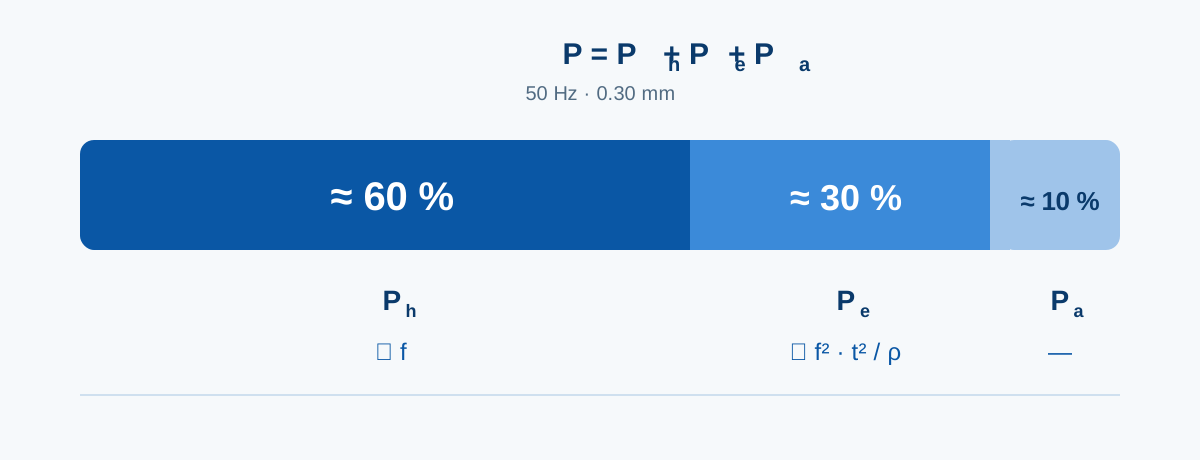
- Hysteresis loss: the energy needed to reverse magnetic domains. It is proportional to frequency and depends most on purity, grain size and internal stress; annealing improves it, cutting stress makes it worse.
- Eddy-current loss: currents induced inside each sheet by the alternating field. It rises with the square of frequency and thickness and falls with resistivity.
- Anomalous (excess) loss: from the interaction of domain-wall movement with the microstructure; smaller but not negligible.
At 50 Hz and 0.30 mm the split is roughly 60 % hysteresis, 30 % eddy current and 10 % anomalous, changing with thickness and frequency. This matters: where hysteresis dominates, improvement comes from material and annealing; where eddy currents dominate, from thinner gauge and coating.
2. How it reaches the finished machine
Transformers: core loss is the no-load loss. It is consumed 24 hours a day whenever the transformer is energized, whatever the load, across all 8,760 hours of a year. It sets the efficiency class (for example GB 20052 in China or EU Ecodesign Tier 2) and the temperature rise; as a rule of thumb, every 6–8 °C of extra temperature roughly halves insulation life.
Motors: core loss is part of the total loss and, with copper loss, sets the efficiency class and temperature rise. High-efficiency motors (IE3/IE4) are especially sensitive, because copper loss is already low and the share of core loss rises.
Noise: vibration from magnetostriction depends on induction and orientation. GO tension coatings and domain refinement directly affect noise, which is why low-noise transformers specify particular grades.
3. What 0.01 W/kg is worth
- Take a distribution transformer core with 1.5 t of GO: a difference of 0.01 W/kg is 15 W for the whole core.
- Over 8,760 hours a year that is 131 kWh.
- Over 20 years it is about 2,600 kWh for a single transformer.
That looks small. Seen another way:
- At 0.03 W/kg the difference is about 7,900 kWh per transformer over 20 years, which can match or exceed the price difference of a tonne of steel.
- For a maker building 10,000 transformers a year, 0.01 W/kg means about 1.31 million kWh a year.
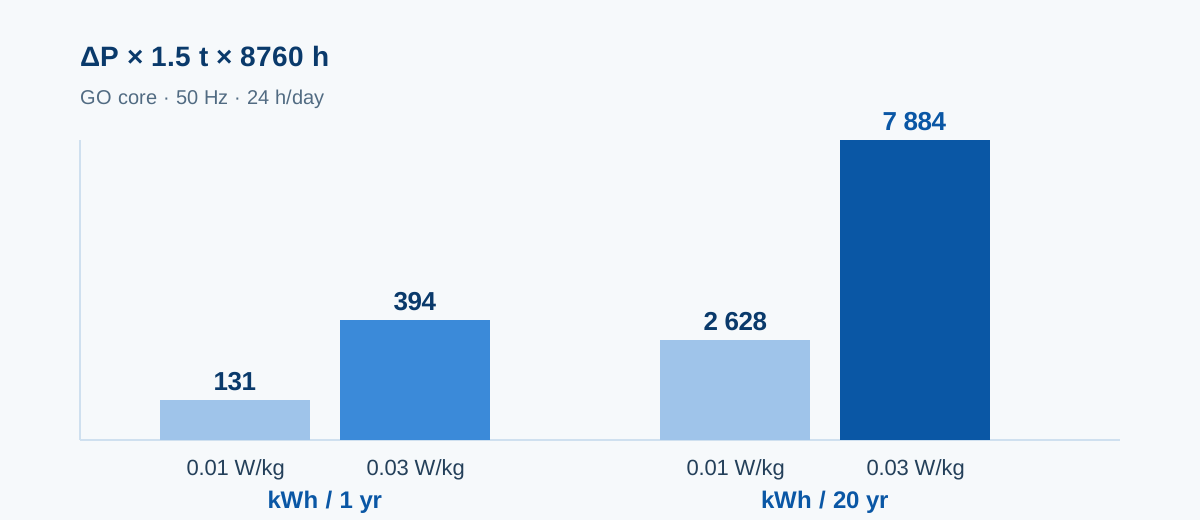
One boundary must be clear: real operating induction and frequency differ from the test conditions, so a loss difference cannot be extrapolated linearly. This calculation is for judging orders of magnitude and comparing options, not a promise of exact energy savings.
4. Why the “same grade” can have different losses
This is the trap purchasers fall into most often. Coils of the same grade from different heats can measure differently within the guaranteed maximum, because of:
- Small variations in composition and inhibitors.
- Differences in the annealing cycle: temperature, atmosphere, heating and cooling rates.
- Whether, and how, the steel is domain-refined (laser scribing spacing and depth).
- Coating type and tension level.
- Sampling position: head, tail and edge differ.
- Test equipment and sample preparation, including unrelieved cutting stress.
In other words, the grade only sets a ceiling; it does not tell you what the coil in your hands measures. That is why whether a quotation shows measured values is a detail that makes a real difference.
How core loss affects quotation and acceptance
The usual practice is to quote by grade: one price for B30P105, another for B30G130. It is simple, but it hides the spread inside one grade, which in a transformer, where every 0.01 W/kg counts, is real money. We put it on the table:
- Quotations come with the measured values from the mill certificate of the lot (P17/50 or P15/50, B8, thickness, coating), so customers do not have to guess.
- The contract states the guaranteed values and the acceptance method, including sampling position and pass criteria, so both sides judge by the same rule.
- Traceability runs heat number → mother coil → slit coil → laminations → core, with the numbers kept on every step.
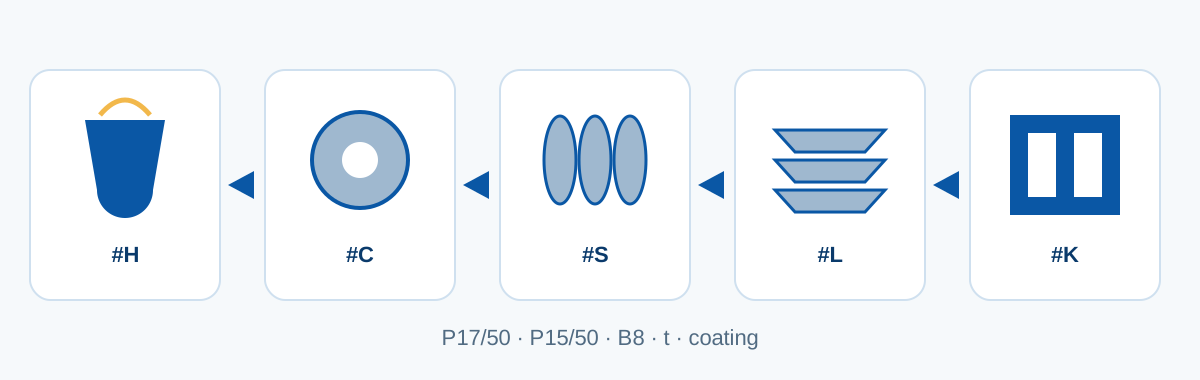
A more useful way to compare offers: do not compare price per tonne alone; compare “material cost per core + 20 years of no-load energy”. The first is visible, the second is hidden, and the hidden one is often larger.
From coil to core: where processing pushes loss up
A good coil can be spoiled in processing. This is not exaggeration; it is the most overlooked source of core loss.
| Step | What happens | Key controls |
|---|---|---|
| Uncoiling / slitting | Wide coil cut into strips | Edge burr, camber, rewind tension |
| Cut-to-length / mitre cutting | Strips cut into laminations; GO often with 45° joints | Angle accuracy, length tolerance |
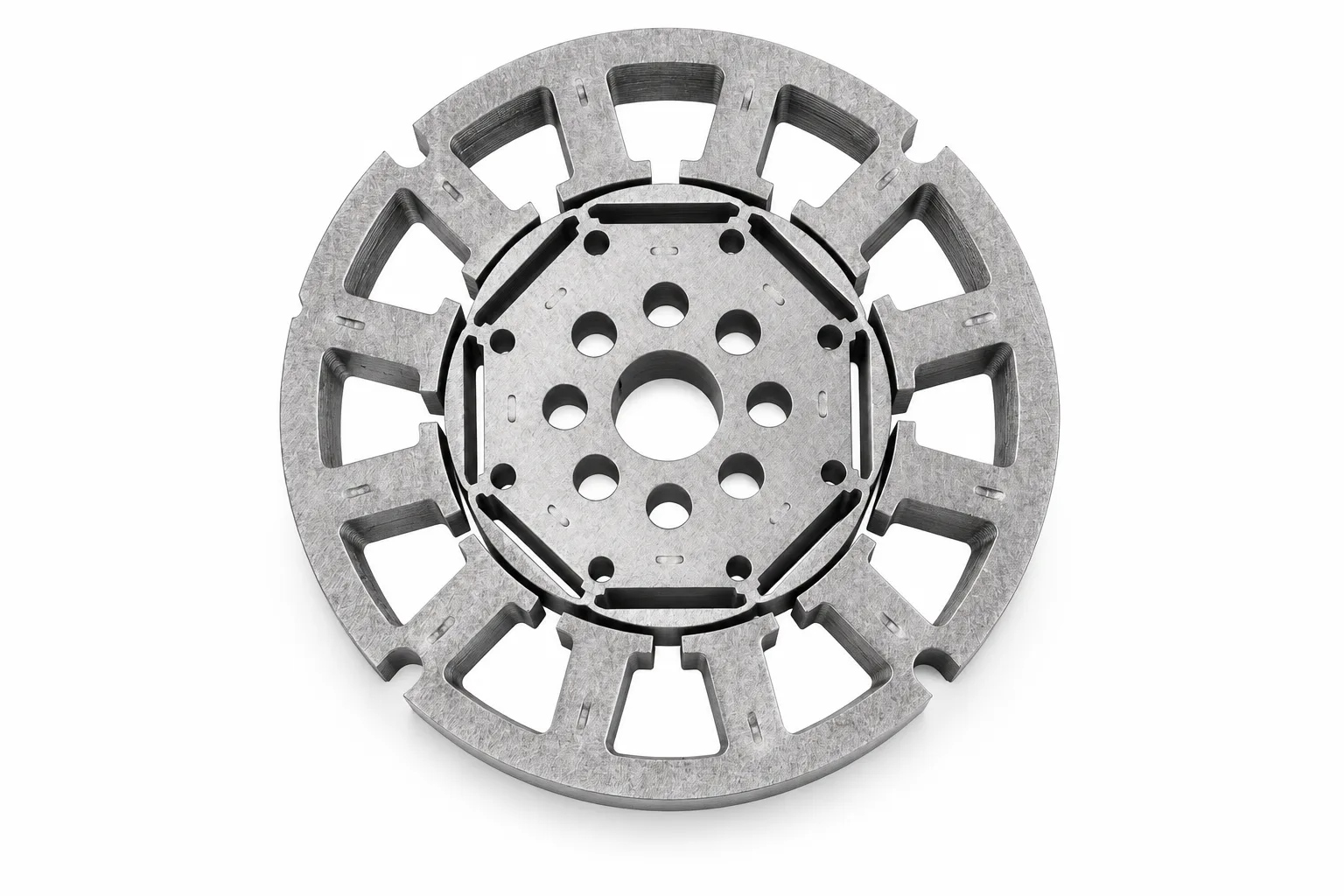
| Stamping | Motor stator and rotor or transformer laminations | Die clearance, stroke rate, edge wear |
| Stacking | Laminations stacked into cores, interleaved or step-lap | Stacking factor, clamping force, insulation |
| Annealing | Relieves processing stress | Temperature cycle, atmosphere, coating tolerance |
| Varnishing / bonding | Curing and insulation | Film thickness, curing temperature |
(1) Excess burr
Burrs bridge neighbouring sheets and short-circuit the eddy-current path. Slitting burr is usually held to ≤ 0.02 mm, and stamping burr even tighter. With wrong die clearance or worn edges burr grows quietly and cannot be seen by eye.
(2) Cutting stress left in place
Cutting plastically deforms a band of about 5–10 mm next to the edge, raising local loss. In small motor stators the teeth are narrow, so this band is a large share. Stress-relief annealing (about 750–820 °C, non-oxidizing atmosphere) recovers much of the loss, provided the coating survives the temperature.
(3) The wrong cutting method
Laser cutting leaves a heat-affected zone and recast layer that harms grain-oriented structure more than stamping does; wire EDM and waterjet give good edges but are slow. For series production, stamping is the most stable.
(4) Damaged coating
Scratches, folds, oil contamination or incomplete burn-off in annealing all cause local insulation failure. Interlaminar shorts feed back into local overheating and further damage, and finally show up as abnormal temperature rise.
(5) Over-tight stacking and clamping
Some clamping is needed, but too much compressive stress raises loss, especially in GO. A stacking factor of about 0.95–0.97 is usual; too loose and noise and vibration rise.
Where HXES fits in this chain
We cover two stages, material and processing. Our Guangzhou office handles quotations, documents and export; the Hunan plant does slitting, cut-to-length, step-lap mitre cutting, stamping and core stacking. Incoming thickness is 0.18–0.50 mm with mother coils up to 1,250 mm wide; slit width tolerance is ±0.2 mm and burr ≤ 0.02 mm, and core windows and diagonals are held to the drawing.
Choosing a grade, and six common mistakes
Five steps
- Define the flux path: fixed or rotating? Fixed means GO, rotating means NGO. How high is the frequency? Higher frequency points to thinner gauge.
- Set the loss budget: work back from the efficiency target, not forward from a grade. First calculate the allowed no-load or total loss, then the W/kg budget.
- Choose the thickness: balance the loss budget against stacking factor and processing cost.
- Choose coating and process: annealed or not, oil-immersed or not, bonded or not. These three questions decide the coating code.
- Agree delivery form and acceptance: coil, strip, laminations or finished core; which data the mill certificate must show; how retesting and disputes are handled.
Six mistakes
- Looking at the grade and not the measured values: the spread between lots can cost an efficiency class.
- Looking at loss and not induction: low-induction steel needs a larger core and longer windings, so load loss can rise.
- Thinking thinner is always better: thin gauge adds pressure on stacking, cutting and cost, and the net gain is not always positive.
- Ignoring the coating: a coating that does not match the annealing process can lose its insulation in one anneal.
- Judging electrical steel with structural-steel tolerances: thickness variation, camber and edge quality affect stacking and loss more than many expect.
- Mismatching direction: GO in a rotating field wastes money; low-grade NGO in a large transformer fails the efficiency rules.
Typical applications
| Application | Usual type | Thickness | Focus |
|---|---|---|---|
| Power and distribution transformers | GO | 0.18–0.30 mm | Core loss, induction, noise, oil-resistant coating |
| Reactors and instrument transformers | GO | 0.23–0.30 mm | Core loss, loss near air gaps |
| Industrial motors (IE3/IE4) | NGO | 0.35–0.50 mm | Core loss, induction, punchability |
| EV drive motors | NGO, thin and high-strength | 0.20–0.35 mm | High-frequency loss, strength, fatigue |
| Generators and wind generators | NGO | 0.35–0.65 mm | Core loss, dimensional stability |
| Appliance and compressor motors | NGO | 0.50 mm | Cost, punchability |
| Small dry-type transformers, ballasts | NGO | 0.35–0.50 mm | Cost, nesting yield |
Frequently asked questions
Are an electrical steel coil and a silicon steel sheet different things?
They are two forms of the same material. The mill delivers coils; after slitting, cutting or stamping they become sheets or laminations. “Coil” stresses the delivery form and further processing; “sheet” means it is already cut to size.
How heavy is a coil?
Usually 3–5 tonnes, with an inner diameter of 508 mm or 610 mm. Coil weight affects lifting, uncoiling equipment and remainder handling, so confirm it when ordering.
Why does grain-oriented steel cost so much more?
The process is long: composition control, inhibitors, repeated cold rolling, decarburizing anneal, high-temperature secondary recrystallization, coating and domain refinement, and each stage affects yield. You pay for process and yield, not just silicon.
Can a 50 Hz grade be used at 60 Hz?
Yes, but the loss changes. Eddy loss rises with the square of frequency and hysteresis loss with frequency, so at the same induction the loss is higher at 60 Hz. For 60 Hz markets check the values at 60 Hz rather than reusing the 50 Hz figures.
Must laminations be annealed after cutting?
It depends on the requirement. Ordinary industrial motors are often not annealed and rely on grade margin; high-efficiency motors, low-loss transformers and small cores with a large share of cutting stress gain clearly from annealing. Check first that the coating can take about 800 °C.
How can I tell whether a supplier’s grade is reliable?
Three steps: ask for the mill certificate of the lot (not a brochure), ask for the heat number, and agree how retesting and disputes are handled. Suppliers willing to put these in the quotation are usually willing to stand behind their data.
Final thoughts
Electrical steel specification sheets look much alike; the differences hide in three places: the spread of measured values within one grade, how well coating and processing match, and who takes responsibility when something goes wrong.
Core loss deserves its own discussion because it is the one number that appears in the technical agreement, the efficiency regulations, the quotation and the acceptance report. It decides how large the core is, how hot it runs, whether it reaches its efficiency class, and what the steel is really worth.
What customers need is not a lower unit price but a price they can check: grade, measured values, heat number, tolerances and delivery, all in writing. If you are choosing a grade, send us the drawing or grade and we will talk through the data. Use our inquiry form or write to sales@huaxinelecsteel.com.
Ranges in this article come from public standards and common grade data and are for selection reference only. The properties of a specific grade are governed by the mill certificate and the technical agreement between the parties.

