


Electrical steel or silicon steel? A complete guide from the name to the finished core
Two names, one family of soft magnetic steel. This guide explains what really separates one sheet from another – silicon, grain orientation, thickness, coating and processing – and how to specify it so that the core performs.
The short version
In nearly every industrial context, “electrical steel” and “silicon steel” are the same material. The questions that decide a project are the grade, the thickness, the grain structure, the coating and the quality of processing – not the name.
- Electrical steel names the purpose and silicon steel names the alloy. They are not two different steels.
- Silicon raises electrical resistivity and cuts eddy-current loss, but also makes the strip harder and more brittle. Commercial grades balance the two.
- The real dividing line is grain orientation: grain-oriented steel for transformers, non-oriented steel for motors.
- Agree on grade, thickness, guaranteed loss and its test condition, coating and processing. That is what can be checked on delivery.
Buyers, designers and mills mix the two words every day. Problems rarely come from the word itself; they appear when the stamped sample is measured and both sides discover they had different grades in mind. Starting from the magnetic circuit, the frequency, the loss target and the way the core will be made avoids that.
| Name | What it describes | Where you meet it |
|---|---|---|
| Electrical steel | The function: steel made for electromagnetic devices | Design documents, standards, motor and transformer makers |
| Silicon steel | The composition: iron alloyed with silicon | Mills, traders and purchase orders |
| GO / NGO | The grain structure, which sets the magnetic direction | Transformers versus motors |
1. One material, two names
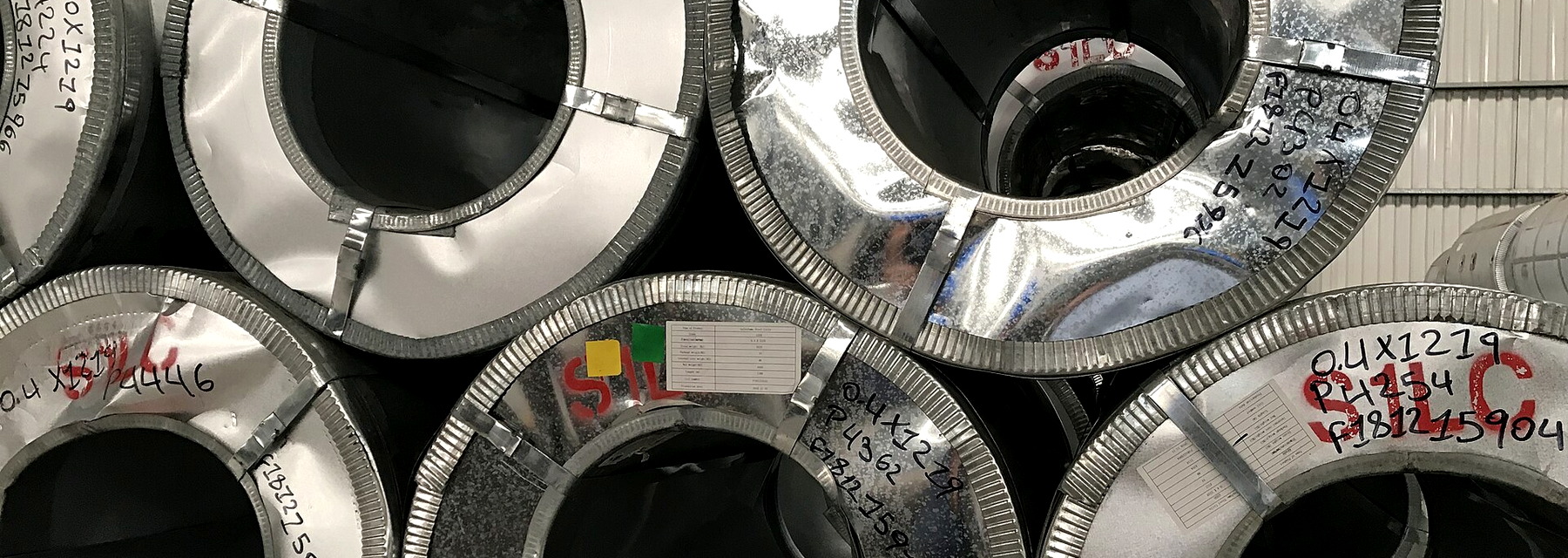
“Electrical steel” is a name based on use: the steel is there to carry magnetic flux, not to carry load, in motors, transformers, generators, reactors and relays. “Silicon steel” is a name based on chemistry: iron with a deliberate addition of silicon, the element that makes it suitable for magnetic cores. Trade documents also use silicon electrical steel, lamination steel and core steel for the same family.
Both names describe the same product from different angles, much as one person might say “stainless steel” and another quote its alloy designation.
Why both names are still in use
Early technical literature favoured “silicon steel”; as the motor and transformer industries matured, “electrical steel” became the formal category in standards. In China both are common: mills and traders tend to say 硅钢, designers and standards say 电工钢. The mixture is harmless in conversation but risky in a contract: an order that only says “silicon steel” lets a supplier deliver any class that fits the words.
Five questions to settle after the name
- Which standard and grade? For example GB/T 2521, IEC 60404 or EN 10106/10107, and a grade such as B27P100 or B50A470.
- What nominal thickness and tolerance? Commercial sheet runs from about 0.18 to 0.65 mm.
- Which guaranteed loss and induction values, under which test condition? P1.5/50 and P1.7/50 cannot be compared directly.
- Which coating type and thickness? It governs insulation between laminations, corrosion resistance, welding and stamping.
- In what form is the material delivered and who does which processing step? Coil, slit coil, sheets, stamped laminations, annealing.
Putting these five answers into the technical agreement does more than any discussion of terminology. A useful rule: the name is for talking, the grade is for accepting the goods.
2. The job: carrying flux, not load
Electrical steel is a soft magnetic material. “Soft” refers to magnetism, not strength: it magnetises and demagnetises easily, its coercivity is low and its hysteresis loop is narrow, so repeated magnetising wastes little energy.
Two losses set efficiency and temperature
Hysteresis loss is the energy spent moving domain walls and flipping magnetic domains every cycle. It equals the area of the B-H loop, so a wider loop means more loss, and a higher frequency means more cycles per second.
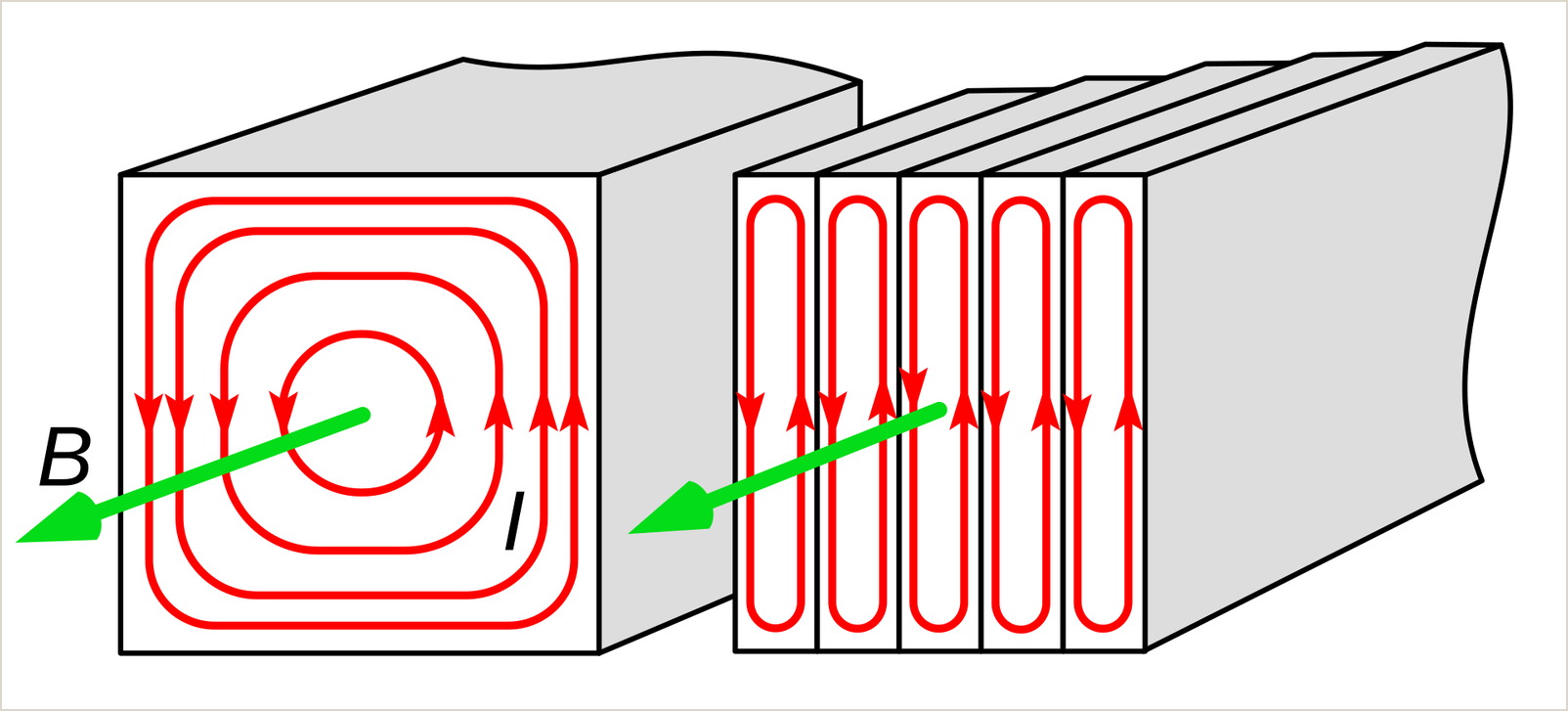
Eddy-current loss comes from currents that the alternating field induces inside the metal; they heat the steel through its own resistance. The loss climbs quickly with frequency and flux density and is very sensitive to thickness: at the same frequency and induction, halving the thickness brings the classical eddy-current loss down to roughly a quarter. That is why cores are built from thin sheets with an insulating coating between them.
Engineers also talk about anomalous or excess loss, but hysteresis and eddy currents are the two levers to understand first.
Three figures designers compare
- Permeability – how easily the steel is magnetised. Higher permeability needs less magnetising current for the same flux, which helps efficiency and power density.
- Core loss – total loss per kilogram at a stated induction and frequency, in W/kg. A loss value without its test condition means little.
- Resistivity – the higher it is, the weaker the eddy currents. Raising it is the main reason for adding silicon.
Saturation induction, stacking factor, coating adhesion, yield strength and magnetostriction also appear in specifications. Each matters for particular designs; none of them is simply “the higher the better”.
Why ordinary carbon steel or stainless steel will not do
Carbon steel is cheap and strong, but its hysteresis and eddy-current losses are much higher and its magnetic properties vary from batch to batch. In a core it runs hot and wastes energy. Stainless steel is designed for corrosion resistance: austenitic grades are practically non-magnetic, and ferritic grades, though magnetic, do not reach the low loss of electrical steel. A core is a magnetic component first and a mechanical part second.
3. Silicon: trading resistivity for efficiency
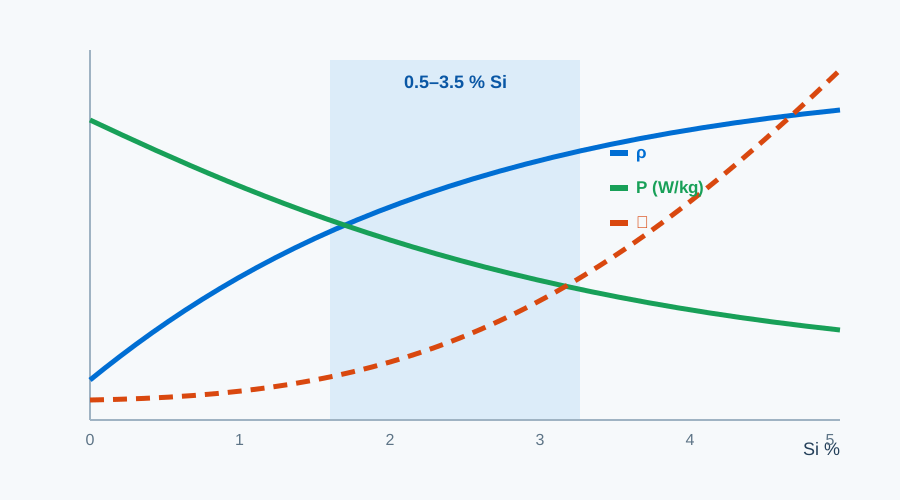
Silicon dissolved in iron raises its electrical resistivity, and eddy-current loss falls as resistivity rises. For transformers and high-speed motors the gain is direct. The gain flattens as the silicon content increases, while processing becomes harder.
Silicon also lowers magnetocrystalline anisotropy and coercivity, so domain walls move more easily: hysteresis loss falls and permeability rises. The price is a slightly lower saturation induction, so high-silicon grades are strongest on loss and weaker where a design needs very high flux density.
More silicon also makes the strip harder and more brittle. Stamping produces more burr and edge cracking and dies wear faster, especially on thin gauges. Commercial grades therefore contain roughly 0.5–3.5 % silicon: grain-oriented steel close to 3 %, non-oriented grades across a wider range.
Where the silicon comes from
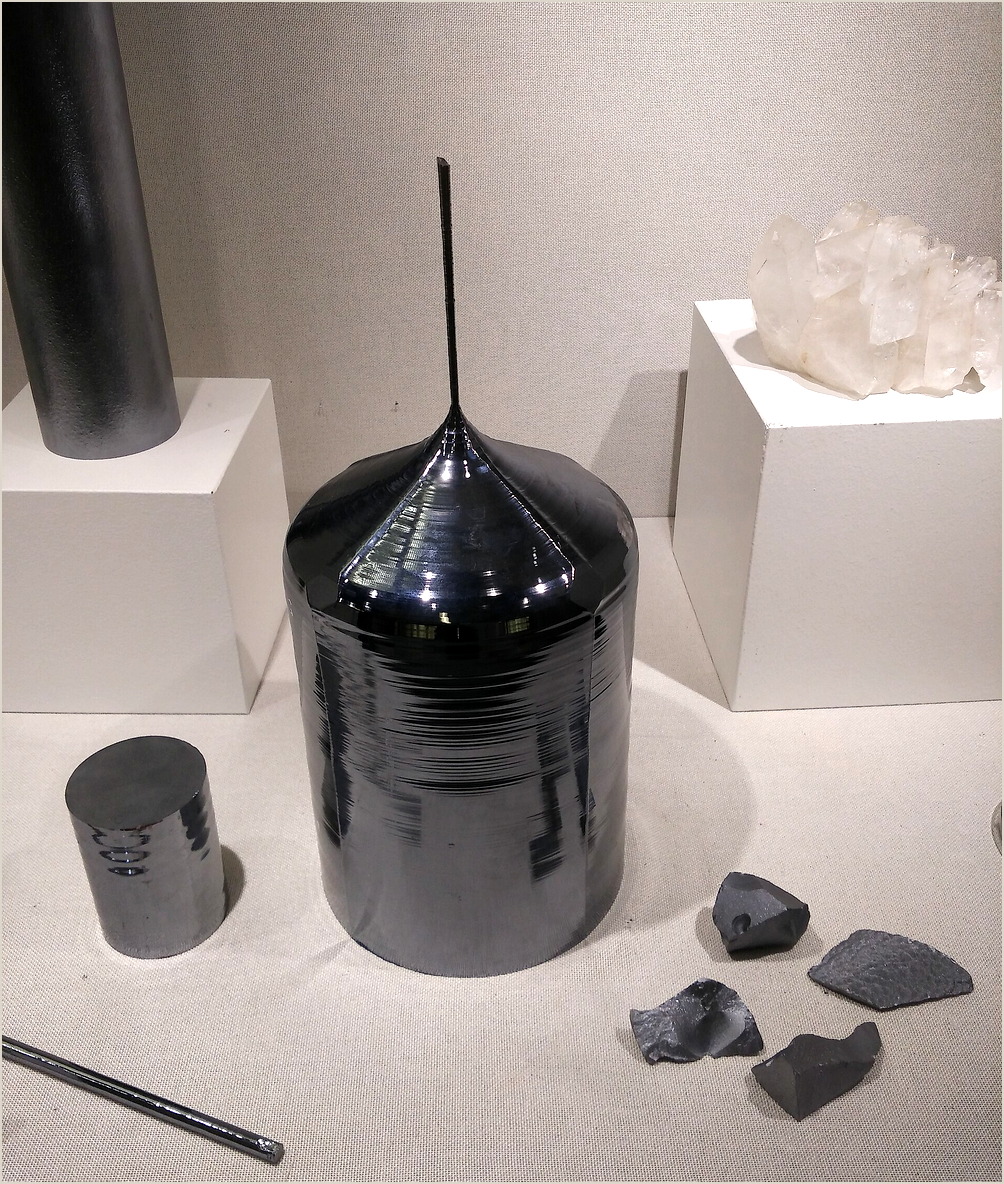
Silicon is added at the steel plant as ferrosilicon, a metallurgical alloy, not as semiconductor-grade silicon. The aim is an accurate composition, clean steel and stable casting and rolling; the price and recovery of ferrosilicon feed into grade cost. Hot rolling, cold rolling, annealing and coating then create the texture and surface the grade needs.
4. Grain structure: GO and NGO
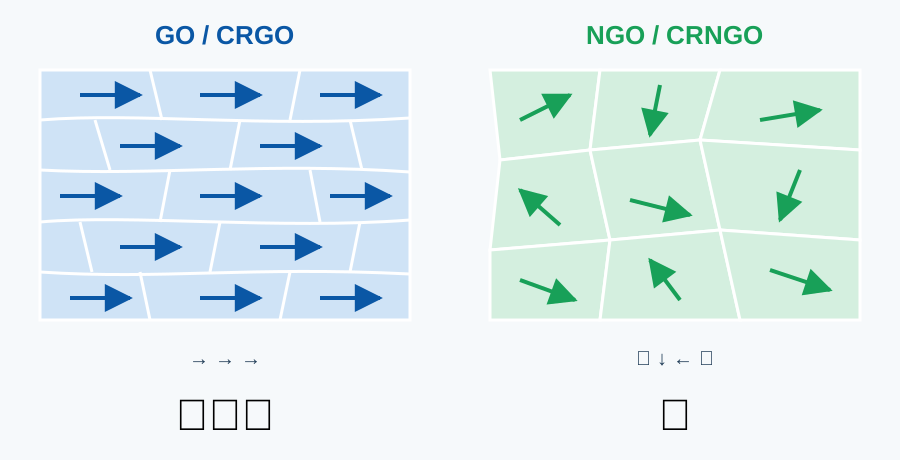
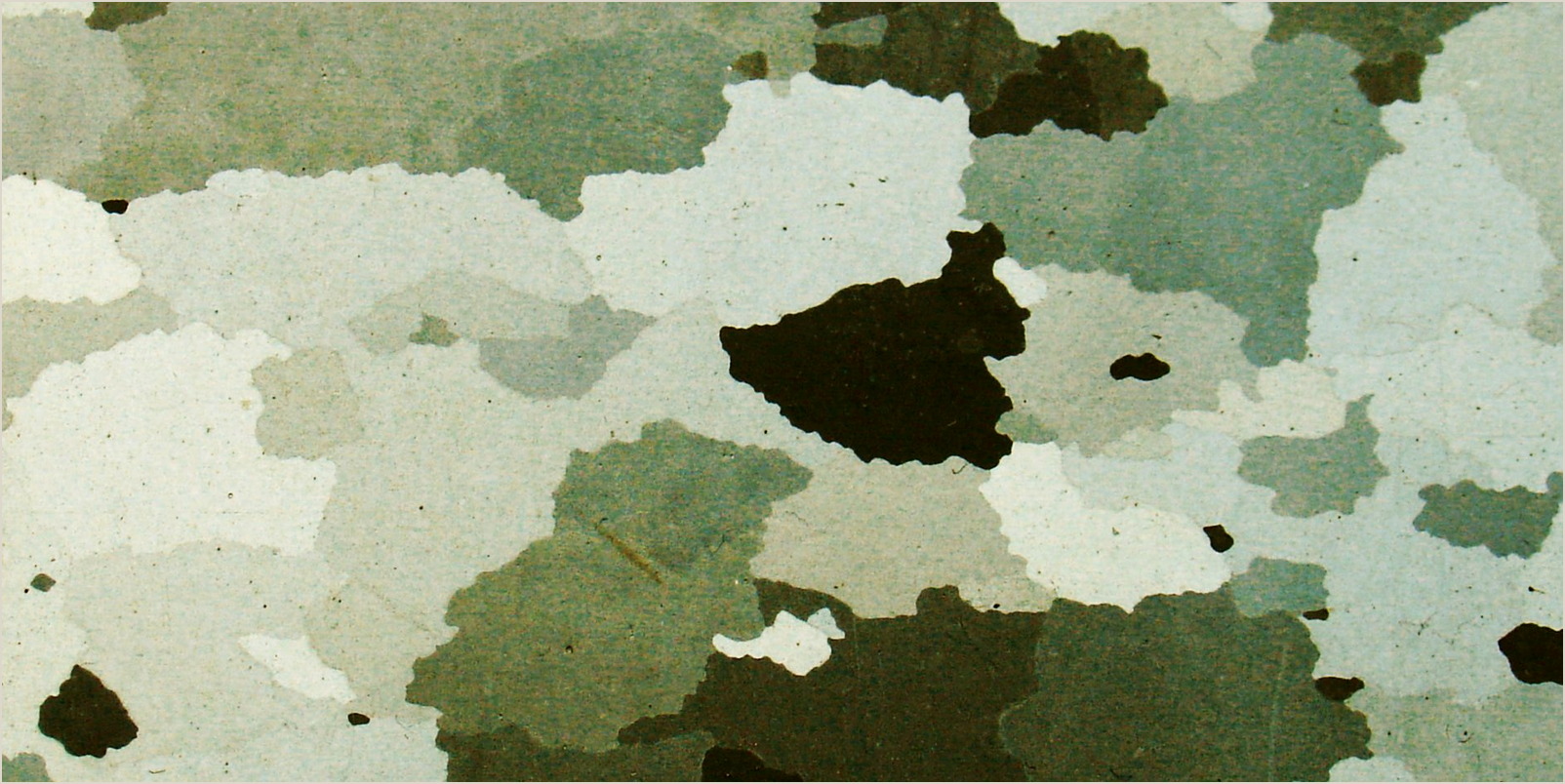
Grain-oriented steel (GO or CRGO) is rolled and annealed until most crystals share the Goss texture, with their easy magnetisation axis along the rolling direction. Along that direction loss is very low and permeability very high; across it, performance drops sharply. That matches a transformer core, where flux follows the strip. Every step – composition, hot and cold rolling, decarburising, high-temperature annealing, coating – serves the texture, which is why GO costs more.
Non-oriented steel (NGO or CRNGO) has more random grains and useful properties in every direction of the sheet. Stators and rotors see a rotating field, so even properties matter more than a record low loss in one direction. NGO is a family, not one product: standard, high-grade, thin-gauge and high-strength series differ widely in loss and price.
| Property | GO / CRGO | NGO / CRNGO |
|---|---|---|
| Grain structure | Highly aligned (Goss texture) | Largely random |
| Magnetic direction | Best along the rolling direction, much worse across | Similar in all directions |
| Core loss | Very low along the rolling direction | Higher than GO along its best direction, but even |
| Permeability | Very high along the rolling direction | Good in all directions |
| Typical use | Power and distribution transformers, reactors, instrument transformers | Motors, generators, relays, appliances |
| Cost | Usually higher | Lower, rising with grade |
| Processing focus | Keep flux along the rolling direction; limit cutting stress | Stamping burr, annealing, stacking consistency |
How to read a grade name
| Grade | How to read it | Key meaning |
|---|---|---|
| B27P100 | Baosteel / 0.27 mm / P = high-permeability grain-oriented / 100 | Max. 1.00 W/kg at P1.7/50 |
| 30Q120 | 0.30 mm / Q = grain-oriented / 120 (Chinese standard) | Max. 1.20 W/kg at P1.7/50 |
| B50A470 / 50W470 | 0.50 mm / A or W = non-oriented / 470 | Max. 4.70 W/kg at P1.5/50 |
The first digits give the nominal thickness in hundredths of a millimetre, the letter gives the family, and the number is the guaranteed loss in hundredths of a W/kg. Mills add coating codes and suffixes, and GO and NGO are tested at different inductions, so check the test condition before comparing two numbers. Ask first where the flux will run; a low loss in the wrong direction is wasted.
5. Selection: draw the magnetic circuit first
Work in this order: flux direction, then frequency and induction, then efficiency and cost targets, then processing and supply. Each step narrows the next.
Transformers: grain-oriented first
Transformer flux runs along the laminations, which suits GO’s low loss and high permeability in the rolling direction; thinner GO lowers eddy-current loss further. Distribution transformers are judged on no-load loss, and GO’s low magnetostriction also helps noise. Wound cores and step-lap stacking exist to use the direction well. The advantage shrinks quickly wherever flux leaves the rolling direction, so avoid needless cross-flux, and remember that shearing, punching and clamping stress all take some of the performance away.
EV traction motors: thin non-oriented steel
High speed and high fundamental frequency make eddy currents a larger share of loss, so thin NGO of 0.20–0.30 mm beats standard 0.35 or 0.50 mm. Thinner is not free: burr is harder to control, stacking factor drops, dies wear faster and the material costs more. Rotor bridges in high-speed motors also need strength, so high-strength NGO grades are used. Selection becomes a balance of magnetic, mechanical and fatigue properties.
Industrial motors and appliances: balance cost and efficiency
Fans, pumps, compressors and appliance motors are built in volume, and standard NGO of 0.35, 0.50 or 0.65 mm usually gives the best value. Stable stamping, coating adhesion and reliable supply matter as much as loss. Moving up a grade or to a thinner gauge for a higher efficiency class is worth it only when lifetime energy savings outweigh the price and process differences.
| Application | Flux pattern | Usual choice | What to check |
|---|---|---|---|
| Power and distribution transformers | Fixed, along the strip | GO, 0.23–0.30 mm | P1.7/50, magnetostriction, coating, core design |
| Reactors and instrument transformers | Fixed, sometimes with an air gap | GO or high-grade NGO | DC bias, air gap, noise, temperature rise |
| EV traction motors | Rotating, high frequency | Thin NGO, 0.20–0.30 mm | High-frequency loss, yield strength, burr, stacking factor |
| Industrial and appliance motors | Rotating, mains or variable frequency | Standard NGO, 0.35–0.65 mm | Efficiency class, stampability, cost, supply |
| Generators and wind power | Rotating, low to medium frequency | NGO, 0.35–0.50 mm | Low loss, consistency, dimensional accuracy |
Purchase checklist: turn a vague request into terms you can check
- Standard and grade: the governing standard, the grade, the mill, and whether an equivalent is acceptable.
- Dimensions: nominal thickness and tolerance, width, thickness variation across the width, camber.
- Magnetic properties: guaranteed loss and induction, test condition, sampling method.
- Coating: type, thickness, adhesion, insulation resistance, suitability for welding and stamping.
- Surface and edges: rust, scratches, edge cracks, burr.
- Processing and annealing: suitability for stamping, the annealing cycle, the coating’s temperature limit.
- Supply and consistency: heat-to-heat stability, lead time, mill certificate, traceability.
Items 4 and 6 are the ones most often forgotten; many cases of “good material, wrong result” end up at the coating or the annealing. In short: fix the flux path, then the frequency, then the loss, and only then compare prices.
6. From coil to core: processing decides the result
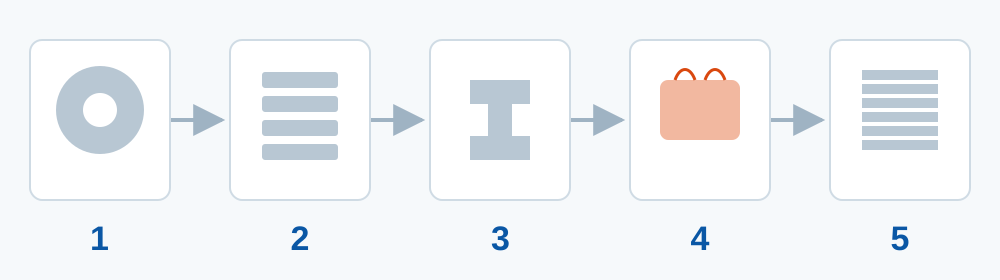
Electrical steel is not a finished product on arrival. Slitting, cutting or stamping, annealing, coating and stacking can each spoil good material or make ordinary material perform consistently. The grade sets the ceiling; processing decides how close the core gets to it.
Slitting and stamping: burr is the hidden enemy
Slitting sets width accuracy and edge quality; wrong width, high burr or heavy edge stress are amplified in stamping and stacking and show up as loss and noise. In stamping, die clearance, edge wear, speed and lubrication decide the burr height and cut-face quality. Burr damages the coating and can bridge neighbouring sheets, giving eddy currents a path again. Thickness variation and camber look like geometry, but they affect stacking accuracy, air gaps and clamping.
Annealing and coating: recovering properties within limits
Cutting leaves stress in the steel, which lowers permeability and raises loss. Stress-relief annealing recovers part of it, but temperature, time, atmosphere and heating and cooling rates must suit the grade and its coating. Too hot can coarsen grains, oxidise the surface or damage the coating; the wrong atmosphere can decarburise or carburise. The coating sets insulation, corrosion resistance, stampability and weldability: too thin and insulation suffers, too thick and the stacking factor drops.
Stacking: the last step and the easiest to overlook
Stacking decides insulation between sheets, stacking factor, clamping and dimensional stability. Riveting, welding, interlocking and bonding each add their own electrical and mechanical contacts. If stacking creates conducting paths between sheets, eddy currents bypass the coating and loss rises; clamping that is too hard or too loose affects noise and temperature.
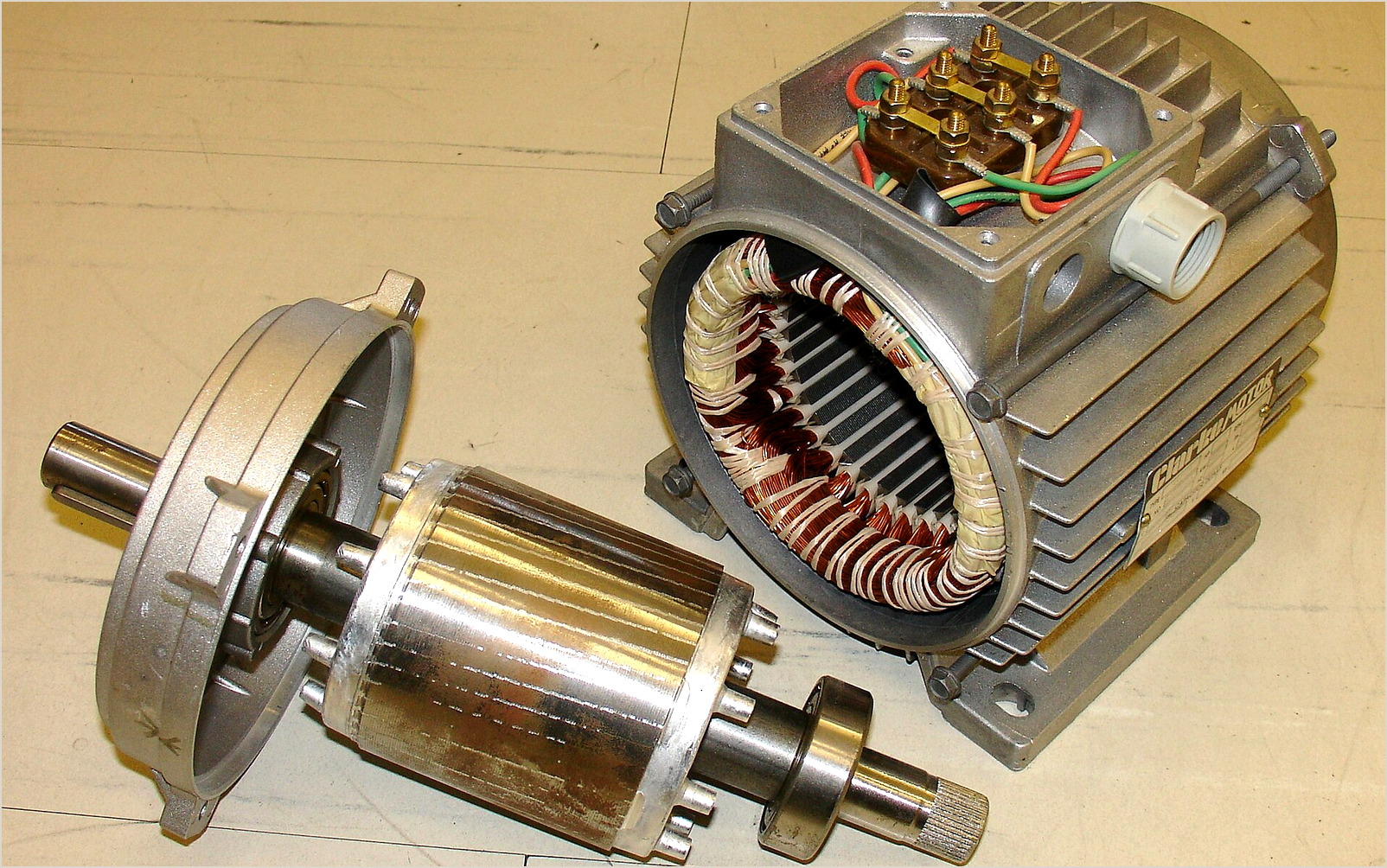
This is why experienced buyers audit both the grade and the processing. HXES supplies Baosteel electrical steel together with its own processing plant in Hunan – slitting, cutting to length, stamping and core stacking under one quality system, traceable by coil number – so that the performance of the grade reaches the finished core.
7. Six common misconceptions
- “Electrical steel and silicon steel are two materials.” In most industrial use they are two names for one family. Confirm the grade and the technical agreement, not the word.
- “The more silicon, the better.” Silicon lowers eddy-current loss, but adds brittleness and die wear and slightly lowers saturation induction. Commercial grades sit at a balance point.
- “Stainless steel can replace electrical steel.” Stainless steel solves corrosion, not loss. Austenitic grades are almost non-magnetic; ferritic grades are magnetic but not low-loss or consistent enough for cores.
- “Thinner is always better.” Thin gauges cut eddy-current loss but raise cost and burr risk and lower stacking factor and stiffness. Whether it pays depends on frequency, induction and manufacturing capability.
- “Same grade, same performance.” Cutting, annealing, coating, stacking and clamping all change the final core loss. The material is the starting point; the process decides the outcome.
- “A lower loss figure is always better, whatever the test condition.” Losses at P1.5/50, P1.7/50 or other frequencies and inductions cannot be compared. Align the test condition first.
8. Conclusion: it is the specification, not the name
Are electrical steel and silicon steel the same material? In nearly all industrial settings, yes: both mean iron-based soft magnetic steel alloyed with silicon for electromagnetic devices. One name stresses the use, the other the alloy.
What decides a project is everything behind the name: grade, grain structure, thickness, coating, loss, flux direction, processing quality and supply stability. So instead of asking “is this electrical steel or silicon steel?”, ask: which grade, what thickness, what guaranteed loss, which coating, where does the flux run, and how will it be stamped and annealed? Once those are answered, the name no longer matters.
If you are preparing a new project, fill in the one-page request below and send it with the inquiry form or to sales@huaxinelecsteel.com. HXES replies with a quotation within 24 hours on working days.
Frequently asked questions
Are electrical steel and silicon steel the same material?
In most industrial use, yes. Both mean the iron-silicon soft magnetic steel used in motors, transformers and generators. Strictly, electrical steel refers to the use and silicon steel to the composition; contracts should name the grade and standard.
Why can’t ordinary carbon steel be used for a transformer core?
Its hysteresis and eddy-current losses are higher and its magnetic properties less consistent, so the core runs hotter and less efficiently, and in severe cases overheats.
Why does thickness matter?
Eddy-current loss depends strongly on thickness: at the same frequency and induction, half the thickness gives roughly a quarter of the classical eddy-current loss. High-frequency and high-speed designs therefore prefer thin gauges, weighed against cost, stacking factor and stamping difficulty.
Is stainless steel a kind of electrical steel?
No. Stainless steel is designed for corrosion resistance, not for magnetic cores. Austenitic grades are nearly non-magnetic; ferritic grades are magnetic but generally unsuitable for efficient motor or transformer cores.
What does core loss mean?
The energy a core turns into heat in an alternating field, mainly hysteresis plus eddy-current loss, with excess loss on top. It is given in W/kg and must state the test induction and frequency.
Is grain-oriented steel always better than non-oriented steel?
No. GO is superior only along the rolling direction, which suits transformers with fixed flux. NGO is more even in all directions and suits the rotating field of motors. In the wrong magnetic circuit GO’s advantage disappears.
One-page request template
Before contacting a supplier, fill in this table. It answers in one message the questions that otherwise take several rounds.
| Item | What to fill in |
|---|---|
| Application | Power or distribution transformer; EV traction motor; industrial or appliance motor; reactor or instrument transformer |
| Flux pattern | Fixed direction, rotating field, high frequency, air gap |
| Material family | GO or NGO; need for high strength, thin gauge or a special coating |
| Grade and standard | Exact grade (for example B27P100 or B50A470) or the grade to match; governing standard |
| Dimensions | Nominal thickness, width, tolerances, thickness variation, camber |
| Loss and induction | Guaranteed values with the test condition (P1.5/50 or P1.7/50) |
| Coating and processing | Coating type, thickness and adhesion; slitting, cutting, stamping, annealing, stacking, welding |
| Quantity and delivery | Tonnage or coil weight, heat consistency, delivery date, mill certificate, destination port |
Image credits and references
Photos from Wikimedia Commons are used under their licences with the author named in each caption; CC BY-SA images may be reused only under the same licence. The three schematic drawings were made by HXES to illustrate trends and are not measured data.
- GB/T 2521.1 – Cold-rolled electrical steel, non-oriented strip and sheet
- GB/T 2521.2 – Cold-rolled electrical steel, grain-oriented strip and sheet
- IEC 60404-2 – Measurement of magnetic properties of electrical steel strip and sheet with an Epstein frame
- Baosteel electrical steel product data, as published on the HXES grade pages
This article explains materials and supports selection; it is not a performance guarantee. Grades, loss values, coatings and process parameters follow the current standard, the mill certificate and test reports.

